The intention of this Masters Project is to create Concept Art suitable for a 2D Platformer Game inspired by South Korean mythology with a focus on Creature Design.
Showing posts with label Learning-Outcome-2. Show all posts

Contextual Research: How to Train Your Dragon (DreamWorks, 2010): In Progress...

CREATURE DESIGN: Methods for Designing Varied Sub-Species

How do Concept Artists design varied sub-species that are still recognisable as the original creature?

How to Train Your Dragon (DreamWorks, 2010) is an animated feature film based on the novel by Cressida Cowell (2003). The Concept Artists faced a challenge in designing a fresh take on dragons (Miller-Zarneke, 2010, p.17). The artists, including Nico Marlet, designed a variety of dragon species, shown below, each with unique characteristics.

The Red Death
Louis, D. (2010) Red Death Texture [digital paint]. Available at: http://livlily.blogspot.co.uk/2011/09/how-to-train-your-dragon-2010-color.html (Accessed: 9 June 2014).

Toothless: The Night Fury
Otto, S. (2010) Toothless [pencil & marker]. Available at: http://www.artabase.net/exhibition/5582-designing-dreams-studio (Accessed: 9 June 2014).

Monstrous Nightmare
Marlet, N. and Wei, Z. (2010) Monstrous Final [digital paint]. Available at: http://howtotrainyourdragon.tumblr.com/post/62832390223/to-create-the-monstrous-nightmare-character (Accessed: 9 June 2014).

Gronckle
Marlet, N. (2010) Gronckle Wings [pencil & marker]. Available at: http://howtotrainyourdragon.tumblr.com/post/29421908330/for-the-gronckle-the-how-to-train-your-dragon (Accessed: 9 June 2014).

Deadly Nadder
Marlet, N. (2010) Astrid Concepts [pencil & marker]. Available at: http://howtotrainyourdragon.tumblr.com/post/60883272971/astrid-concepts-by-nico-marlet (Accessed: 9 June 2014).

Hideous Zippleback
Marlet, N. (2010) Two Headed [pencil & marker]. Available at: http://howtotrainyourdragon.tumblr.com/post/68198153255/the-hideous-zippleback-has-the-disadvantage-of-two (Accessed: 9 June 2014).

Terrible Terror
Marlet, N. (2010) Terror [pencil & marker]. Available at: http://muddycolors.blogspot.co.uk/2012_09_01_archive.html (Accessed: 9 June 2014).

The Dragons of Myth
Marlet, N. (2010) Multi-Eye Dragon [pencil & marker]. Available at: http://artofnicomarlet.tumblr.com/tagged/how-to-train-your-dragon (Accessed: 9 June 2014).

Contextual Research: Child of Light (Ubisoft Montreal, 2014): In Progress...

CONTENT: Synthesizing Mythology into a Unique Game Concept

When using a relatively unknown source of inspiration, how does one ensure that the content still resonates with the target audience?

Child of Light (Ubisoft Montreal, 2014) is a 2-dimensional, role-playing platforming game available across platforms. The content is inspired by fairy tales and the art style is inspired by artists from the Golden Age of Illustration in Europe, such as Arthur Rackham.

Screenshot from Child of Light (Ubisoft Montreal, 2014)
Ubisoft Montreal (2014) Child of Light Screenshot: House. Available at: http://childoflight.ubi.com/ (Accessed: 20 August 2014).


The Alchemist by Edmund Dulac: Child of Light's art style was influenced by Golden Age Illustrators from Europe
Dulac, E. (1911) The Alchemist [Illustration: watercolour]. Available at: http://biblioklept.org/2013/12/02/the-alchemist-edmund-dulac/ (Accessed: 20 August 2014).


The developers of Child of Light do not specify whether the narrative content is inspired by fairy tales of a specific location. The Golden Age aesthetic makes it appear to be based mainly upon classical European fairy tales. However, on analysis the field of inspiration appears to be much wider.

Óengus is one of the characters that the protagonist, Aurora meets during her adventure. The name Óengus is taken from the Celtic God of Love. However, the design of the character resembles a mythical character of Japanese origin.

Óengus concept art: inspired by a synthesis of Celtic and Japanese Mythology
Meirinho, S. (2014) Óengus [Concept art: digital]. Available at: hhttps://www.behance.net/gallery/16524339/CHILD-OF-LIGHT-VIDEO-GAME-WORLD-CHARACTERS-DESIGN (Accessed: 21 August 2014).

A possible influence for Óengus (Meirinho, 2014) could have been the Namahage, an example of which can be seen in Yuko's illustration (2009). Another similarity can be seen between Óengus (Meirinho, 2014) and San from Princess Mononoke (Miyazaki, 1997).

Namahage, a Japanese mythical creature.
A possible influence for the design of Óengus (Meirinho, 2014)

Shimizo, Y. (2009) Namahage [Editorial illustration: ink on paper & digital colour]. Available at: http://yukoart.com/work/discovery-channel-yokai-feature/#6 (Accessed: 21 August 2014).


San from Princess Mononoke (Miyazaki, 1997).
A possible influence for the design of Óengus (Meirinho, 2014)

Princess Mononoke (1997) Direct by Hayao Miyazaki [Film]. Japan: Toho Company.


urRu concept art by Brian Froud
Froud, B. (1981) urRu concept art by Brian Froud [watercolour]. Available at: http://www.darkcrystal.com/encyclopedia_urru.php (Accessed: 22 August 2014).


Mountain Spirit Guide (San-Shin Dosa 산신도사).
A type of Bhuddhist Art (Taenghwa 탱화). Date and artist unknown.

Unknown Artist (Date unknown) San-Shin Dosa [Painting]. Available at: http://blog.daum.net/sungn/30 (Accessed: 13 June 2014).


Dosa Tiger study


Contextual Research: Tengami (Nyamyam, 2014): In Progress...

Tengami (Nyamyam, 2014) is an adventure game for iOS platforms. The content of the game is based upon Japanese Mythology. The visual style of the game is inspired by Japanese traditional arts and crafts.
Early concept art from Tengami (Nyamyam, 2014)
Nyamyam (2011) Experimenting with traditional Japanese paper. Available at: http://nyamyam.com/445/tengamigame/first-look-at-tengami-concept-art (Accessed: 20 August 2014).

An example of the Japanese art style, Rimpa
Sakai, O. (Early 1800s) Japanese Maple and Autumn Plants [Ink and color on paper]. Available at: http://www.asia.si.edu/ (Accessed: 20 August 2014).

Contextual Research: Okami HD (Capcom, 2012): In Progress...

AESTHETIC: Developing a Folk Art Aesthetic Suitable for a Platform Game

Is it possible to develop a Folk Art aesthetic suitable for a platform game context?

Okami HD (Capcom, 2012) is an action-adventure game for the Playstation 3. The content of the game is based upon Japanese Mythology. The visual style of the game is inspired by Japanese Sumi-e painting.

A screenshot from Okami HD (Capcom, 2012)
Capcom (2012) Okami HD: Screenshot 7. Available at: http://www.okami-game.com/screens (Accessed: 20 August 2014).

Despite Okami HD (Capcom, 2012) being a 3-dimensional game, it appears to resemble the flat nature of Sumi-e painting. The screenshot shows this especially in the form of the tree. The outline of the tree resembles the brush strokes of Sumi-e, separating it from the background. McGuire (2010) uses the phrase 'emphasis through abstraction' to describe this effect.

An example of Japanese Sumi-e painting
Sesshū, T. (c. 1470–90) Landscape of the Four Seasons [detail of a hand scroll, ink and faint colour on paper]. Available at: http://www.britannica.com/ (Accessed: 19 August 2014).

Using folk art as inspiration for the visual style of Okami HD (Capcom, 2012) is also a thematic motivation. The narrative content of the game (Japanese Mythology) is reflected by the aesthetic. This helps to immerse the player in the created world.

However, one question that arises is whether it was necessary to have a mix of 2D and 3D elements in the level design. Donovan et al. (2014) classified Okami (2006) as "sumi-e/cel-shaded/3D" (referring to the artistic style facet/artistic technique facet/artistic dimension facet). There seems to be a disconnect between the 3D 'dimension facet' and the other choices in design. Perhaps a 2D 'dimension facet' would synthesize the aesthetic more coherently.

Kkachi Bridge

The analysis of Okami HD (2012) prompted the decision to use a 2D 'dimension facet' in this project. The asset design of Kkachi Bridge exemplifies the orthographic view chosen for the game.

An example of Korean traditional painting
Unknown Artist (1700s) Ten Symbols of Longevity [Painting: colours on paper]. Available at: http://www.zozayong.com/ (Accessed: 21 June 2014).

Tokkaebi Tiger (Magpie): Development

Above is third of the Tokkaebi (Devil/Imp) Tigers, the Magpie. It is the messenger and spy for the Tokkaebi Tigers. Below is my development work showing my inspiration and reference.


Tokkaebi Tiger (Masked): Development

Above is a mock up for the Masked Tokkaebi Tiger. I like the direction I am taking where the creatures exist in a Korean folk painting (Min-Hwa) style world.

The presentation of the tiger above is a work in progress:

  • I think the tree needs more refinement. Where the tree branch obscures part of the sun doesn't look convincing at the moment.
  • The tail of the creature could be longer and curve around into the foreground of the image.
  • The format and crop of the layout may need changing too. Would a narrower crop suit the 'folk art' aesthetic? Is there too much empty space above the crouching creature?
  • The mask of the creature could be more convincing. Does it look like the creature just has a contrasting coloured face?

    Below is the development sheet for the Masked Tokkaebi Tiger. I was inspired by the creepy look of an Aye Aye. Also, I found a beautiful Korean kite based upon a Phoenix that inspired the tail of the creature.

    Below is a scroll painting from the Joseon dynasty (1392-1910). I would like to experiment with brushes to create a tree like the pine in the background. Also, close crop of the scroll painting is something I could try with my image above.

    Unknown Artist (late 1700s) Tiger Family [hanging scroll; ink and colour on paper]. Available at: http://www.clevelandart.org/(Accessed/downloaded: 11 July 2014)
  • Yong-Wang Tiger: Development

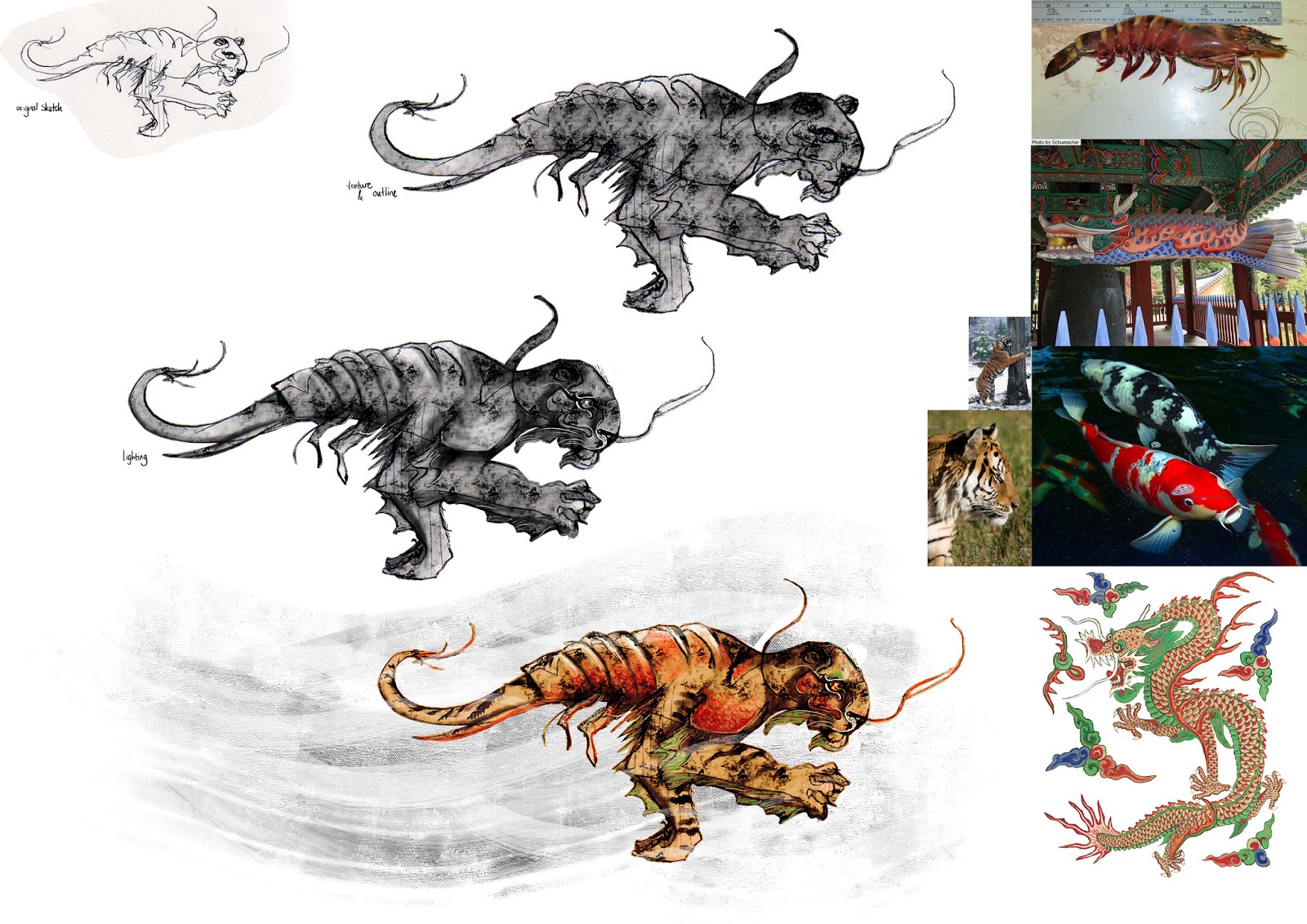
    Above is a coloured version of the Yong-Wang (Dragon) Tiger, based upon a tiger prawn. From this painting, it is hard to see the scale. I will develop a key moment to show that this creature is quite small. Below is the development sheet showing my reference.

    The artwork below (Kim, 2007) was inspiration for the way I presented the Yong-Wang Tiger. Shinwook Kim blends traditional and modern techniques. The artwork below was created by photographing fish, digitally manipulating the image and then printing it onto traditional lacquer paper called Ot-ji (옻지). More information about Kim's technique can be read here: http://londonkoreanlinks.net/2012/05/17/shinwook-kim-korean-folk-painting-in-photography-at-mokspace/

    Kim, S. (2007) Two Korean Sturgeon [Print on lacquer tree paper]. Available at: http://shinwookkim.com/ (Accessed/downlaoded: 9 July 2014)

    Environment Style Inspiration

    Above are my initial thoughts on the mood and style of the world I will be building. I have taken inspiration from fantasy animations such as How to Train Your Dragon (2010) and Children Who Chase Lost Voices (2011). Also, the work of Kazuo Oga is extremely inspiring. He is the background artist for Studio Ghibli.

    The mood and style I would like to capture is that of a sense of calm and a sense of warmth. The images above all capture the sunlight in a beautiful way. There is also a colour palette based mainly around green. There are areas of orange where the sunlight is strongest and cool pinks to represent shade.

    The Korean Tiger

    The first story, Dan-Gun, First Emperor of Korea, featured in Korean Folk-tales (Riordan, 1994, pp.1-3) describes the foundation myth of Korea. A bear and a tiger, who lived in a cave, were summoned by Hwan-Ung, The Heavenly Prince. He said to them:

    "I have chosen you to become the first humans," he told them. "Here, take these twenty garlic bulbs and this mugwort plant; eat them and remain deep in your cave for a hundred days. When you emerge into daylight you will be man and woman."

    Riordan (1994, p.2)

    Korean Folk Tales: Imps, Ghosts and Fairies

    Im, B. and Yi, R. (1962). Korean Folk Tales: Imps, Ghosts and Fairies. Translated by James S. Gale. Reprint, Rutland, Vermont, USA: Charles E. Tuttle Company, Inc., 1977

    Korean Celestial Beings

    Hwan-In 환인

    Celstial Emperor "Lord of Heaven"
    (The Emperor-God of Heaven and Earth)


    Hwan-Ung 환웅

    Celstial Prince "King of Heaven"
    (Son of Hwan-In, Father of Dan-Gun)


    Pung-Baeg 풍백, U-Sa 우사 and Un-Sa 운사

    Lord Wind "Earl Wind", Lord Rain "Chancellor Rain" and Lord Cloud "Chancellor Cloud"
    (The three ministers to Hwan-Ung)


    Ung-Nyo 웅녀

    Bear-Woman "Bear Mother"
    (Mother of Dan-Gun)


    Dan-Gun Wang-Geom 단군 왕검

    The Sandalwood Emperor "High Priest King Sword"
    (Son of Ung-Nyo and Hwan-Ung)


    San-Shin 산신

    Mountain God
    (Associated with the death of Dan-Gun)


    Yong-wang 용왕

    Dragon King
    (Dragon-God of the seas)


    Seon-Nyo 선녀

    Nymph / Fairy


    Tokkaebi 도깨비

    Devil / Imp


    Dosa 도사

    Wise Man / Spirit Guide